Property Development Finance in Scotland
Securing the right property development finance is critical to the success of any project. Local planning requirements, regulatory complexity, and lender criteria make expert guidance essential.
We support property developers throughout Scotland, arranging development finance for residential and commercial projects from site acquisition through drawdowns to final exit.
Request a Callback.
Property development finance in Scotland typically covers 70-90% of total project costs through staged drawdowns tied to build progress. Minimum borrowing sits around £250,000 (bridging fills the gap below that), with terms running 6-30 months.
Scottish projects carry specific requirements that English lenders sometimes misunderstand: LBTT instead of Stamp Duty, mandatory Building Warrants alongside planning permission, and a distinct legal system for conveyancing.
The developers who get funded fastest aren't the ones chasing maximum leverage: they're the ones presenting realistic build programmes, documented exit strategies, and properly costed schemes with genuine contingency buffers.
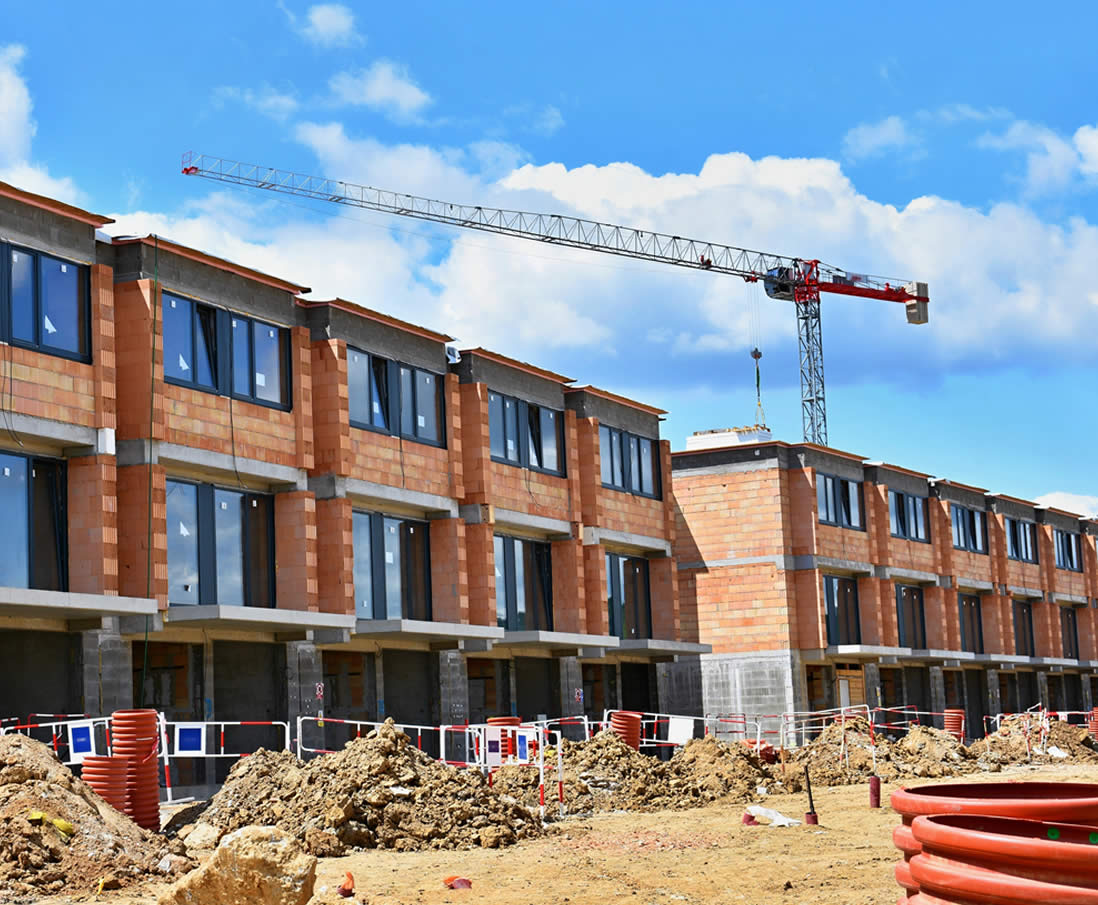
Insight – Managing Stage Drawdowns
One of the most common causes of project delay we see is mismatched expectations around drawdown certification timings. Surveyors must physically inspect works before funds are released. Developers who build realistic inspection lead-times into their cashflow projections and maintain early communication with monitoring surveyors tend to progress far more smoothly than those working to optimistic schedules.
HOW PROPERTY DEVELOPMENT FINANCE IN SCOTLAND WORKS
Development finance is short-to-medium-term funding designed to cover both the purchase of a site and the construction costs needed to complete a project. It's not a mortgage. It's a facility structured around the lifecycle of a build, with money released in stages as work progresses and verified by an independent monitoring surveyor.
This type of development finance suits a wide range of projects:
• Ground-up new builds: single plots through to multi-unit housing schemes
• Conversions: barns, churches, former offices, redundant commercial buildings
• Refurbishments: derelict or below-market-value properties being brought back to habitable standard
• Mixed-use developments: combining residential and commercial elements
• Multi-Unit Schemes: Such as student accommodation or HMOs.
• Build to Rent Schemes: where completed units are retained rather than sold, our build to rent solutions offer a seamless path from construction to letting.
The key distinction from a standard mortgage is the staged release mechanism. You don't get a lump sum on day one. Instead, the lender advances an initial tranche (usually to cover site acquisition), then releases further funds at agreed milestones as construction progresses.
The Funding Process, Step by Step
Stage 1: Initial Advance (Day One Funding)
The lender releases an upfront sum to cover site purchase or early-stage costs. This is typically 60-70% of the land value, though it can reach higher if you're bringing additional security or have a strong track record.
Stage 2: Drawdowns During Construction
As work progresses, you request further tranches of funding. Each drawdown requires a site inspection by a monitoring surveyor who verifies that the work claimed has actually been completed. This is where projects frequently stall: if your build programme doesn't account for surveyor availability and inspection lead times (typically 5-10 working days), you'll hit cash flow gaps.
Stage 3: Interest Treatment
Most development facilities roll up interest, meaning you don't make monthly payments during the build. Instead, interest accrues and is settled when the development loan is repaid. This protects cash flow during construction but means the total cost of borrowing increases the longer the project runs. Every month of delay costs real money.
Stage 4: Exit and Repayment
The loan is repaid either through selling the completed units or refinancing onto a longer-term product like a buy-to-let mortgage. Your exit strategy isn't optional: it's one of the first things a lender assesses, and weak or speculative exits are the single most common reason applications get declined.
HOW MUCH CAN YOU BORROW?
| Metric | Typical Range | Notes |
|---|---|---|
| Loan-to-Cost (LTC) | Up to 90% | Covers land purchase plus build costs combined |
| Loan-to-GDV | 65-75% | Based on the projected value of completed units |
| Minimum facility | £250,000 | Below this, bridging finance (from £50,000) is more appropriate |
| Maximum facility | Up to £50 million | Larger schemes may require syndicated lending |
| Typical term | 6-30 months | Extensions possible but usually incur additional fees |
| Interest rates (2026) | 7.5-12% per annum | Varies significantly based on experience, leverage, and exit strength |
| Arrangement fees | 1-2% of facility | Payable on completion or deducted from initial advance |
| Monitoring surveyor fees | £500-£1,500 per visit | Typically 4-8 visits depending on project scale |
The gap between what you can borrow and what you should borrow is worth thinking about carefully. Pushing to 90% LTC and 75% LTGDV looks attractive on paper, but it leaves almost no margin for cost overruns, programme delays, or a softening sales market. Developers who target 80-85% LTC with a genuine 10% contingency built into their cost plan tend to have far smoother experiences.
FUNDING ROUTES COMPARED
Not every project follows the same financing path. Here's how the three main approaches stack up:
| Metric | Senior Debt - Development Finance | Equity Funding | Joint Venture |
|---|---|---|---|
| How it works | Lender provides staged debt secured against the site | Third-party investor contributes capital for a share of profits | Partner contributes land or capital in exchange for profit share |
| Typical cost | 7.5-12% interest plus fees | 30-50% profit share (no interest) | Negotiated profit split, often 50/50 |
| Cash flow impact | Interest rolled up, repaid at exit | No servicing pressure during build | No servicing pressure during build |
| Control | Developer retains full control | Investor may require governance rights | Shared decision-making |
| Best suited for | Experienced developers with deposit/equity | Developers needing to reduce leverage | Developers without land or full deposit |
| Key risk | Cost overruns erode margin | Profit dilution; misaligned objectives | Disputes over delivery or exit timing |
Many projects use a combination. A typical structure might involve 65% senior debt, 20% equity from an investor, and 15% developer contribution. The right blend depends on your deposit position, risk appetite, and how much profit you're willing to share.
A Word on Joint Ventures
JV structures are increasingly common in Scotland, particularly where a developer has planning expertise and delivery capability but lacks land or capital. We've seen successful arrangements where a landowner contributes a site valued at £400,000, the developer manages planning and construction, and profits are split 40/60 in the developer's favour to reflect the work involved.
The critical thing with any JV is documentation. Profit waterfalls, decision-making authority, dispute resolution, and exit triggers all need to be agreed in writing before a single brick is laid. Poorly structured JVs generate more legal disputes than almost any other arrangement in property development.
WHY SCOTLAND IS DIFFERENT (AND WHY IT MATTERS FOR YOUR FUNDING)
Land and Buildings Transaction Tax (LBTT)
Scotland operates its own property tax regime. For non-residential purchases, the first £150,000 is tax-free, which benefits smaller site acquisitions. The Additional Dwelling Supplement (ADS) sits at 8% in 2026, a significant cost on residential purchases that needs factoring into your appraisal from day one. One useful planning point: buying six or more residential units in a single transaction typically qualifies for non-residential LBTT rates, which can produce meaningful savings.
Building Warrants
This catches out English developers more than anything else. In Scotland, you need both planning permission and a Building Warrant before construction can begin. These are separate applications to separate bodies, and the Building Warrant process can add 8-12 weeks to your programme. Lenders familiar with Scottish projects will expect to see both approvals in place before releasing funds. Lenders who aren't familiar with Scotland sometimes don't understand this requirement, which is one reason working with a broker who knows the Scottish system matters.
The Scottish Legal System
Property transactions north of the border follow Scots law, with different conveyancing procedures, title registration through Registers of Scotland, and distinct requirements around standard securities (the Scottish equivalent of a mortgage charge). Using solicitors experienced in Scottish development transactions isn't just helpful: it's essential. We've seen deals delayed by weeks because an English-based legal team didn't understand the mechanics of a Scottish standard security.
Valuation and Market Evidence
Lenders underwriting Scottish projects rely on local comparable evidence, and in some rural areas, that evidence can be thin. A conversion project in the Highlands might have genuinely strong demand, but if the nearest comparable sales are 20 miles away and six months old, the lender's valuer will take a conservative view. Building a robust evidence pack with recent local transactions, rental data from sources like Registers of Scotland, Citylets Rental Reporting, and demand indicators from property portals can make a real difference to your GDV assessment.
Read our full guide on how Scottish projects differ from the rest of the UK, from legal processes and planning through to valuation and local market considerations: 👉 How Scottish Development Projects Differ from the Rest of the UK
WHAT LENDERS ACTUALLY WANT TO SEE
Forget the marketing material about "flexible lending" and "bespoke solutions." Here's what genuinely moves the needle on an application for property development finance in Scotland:
A fully costed build schedule aligned to current prices. Not estimates from 2024. Not a rough spreadsheet. A detailed cost plan with contractor quotes dated within the last three months, broken down by trade and construction stage. Material costs have stabilised somewhat in 2026 compared to the volatility of 2023-24, but lenders still want to see that your numbers reflect current reality.
A credible, documented exit strategy. "We'll sell them" isn't an exit strategy. "We'll sell six two-bedroom flats in EH7 at £235,000-£245,000 each, based on comparable sales at [specific addresses] in Q1 2026, with marketing commencing eight weeks before practical completion through [named agent]" is an exit strategy. Even better: having an agreement in principle for a refinance onto a buy-to-let product if you're planning to retain units.
Evidence of relevant experience. First-time developers can absolutely access development finance, but the terms will be more conservative and the scrutiny more intense. If you haven't developed before, surround yourself with professionals who have: an experienced contractor, a quantity surveyor, an architect with local planning authority relationships. Lenders fund teams, not just individuals.
Realistic programme timescales. Build in 4-6 weeks of buffer for planning conditions discharge, utility connections, and legal completion. If your programme shows a 12-month build completing in exactly 12 months with zero contingency, the lender's credit team will assume you're either inexperienced or overly optimistic. Neither impression helps your application.
Developer Insight – What Actually Strengthens an Application
Applications that progress fastest are those that arrive fully documented. Clear costings aligned to current market rates, build programmes matched to seasonality, and early confirmation of contractor availability consistently outperform vague estimates and provisional scheduling.
CAN YOU GET 100% DEVELOPMENT FINANCE?
Yes, in specific circumstances. This isn't a myth, but it does require particular conditions:
• You own the development site outright and can offer it as security, with the lender funding 100% of build costs
• You're purchasing significantly below market value, allowing the lender to advance against the higher true value
• You can cross-charge another property as additional security, eliminating the need for a cash deposit
• You enter a JV where a partner contributes the land or capital element
A real example: a developer near Glasgow owned an unencumbered residential plot valued at £180,000. By offering this as additional security alongside the development site, we arranged 100% development finance for a four-unit scheme with zero cash outlay from the developer. The key was that the combined security position gave the lender comfortable LTV coverage across both assets.
These structures work, but they're not available to everyone. If you don't have existing property assets or a below-market-value acquisition, you'll typically need to contribute 10-25% of total project costs as equity.
Common Mistakes That Delay or Kill Projects
Underestimating the drawdown timeline. From requesting a drawdown to receiving funds typically takes 10-15 working days. The monitoring surveyor needs to be booked, attend site, prepare their report, submit it to the lender, and the lender then processes the release. If your contractor expects payment every two weeks and your drawdown takes three, you've got a problem. Build this into your cash flow model from the start.
Ignoring contingency. A 10% contingency on build costs isn't conservative: it's sensible. In Scotland, where weather can halt external works for weeks during winter and where some trades are in short supply outside the Central Belt, 10% should be your minimum. Lenders view contingency as a sign of experience, not pessimism.
Chasing the highest leverage. The developer who borrows 90% LTC at 11% interest with tight covenants is often worse off than the one who borrows 75% LTC at 8.5% with more flexibility. Total cost of capital matters more than the headline advance percentage.
Starting work before the Building Warrant is issued. This sounds obvious, but it happens. Any work done before the warrant is granted may need to be demolished and rebuilt. Lenders won't fund retrospective works, and your insurance may not cover them either.
PRACTICAL COSTS THAT DON'T USUALLY GET MENTIONED
Beyond interest and arrangement fees, budget for these:
• Monitoring surveyor fees: £500-£1,500 per visit, typically 4-8 visits per project
• Valuation fee: £1,500-£5,000 depending on scheme complexity
• Legal fees (lender's solicitor): £2,000-£5,000, payable by you
• Your own legal fees: £2,000-£4,000 for a straightforward scheme
• Building Warrant fees: calculated on project value, typically £1,000-£3,000
• Planning application fees: vary by local authority and project type
• Broker fees: typically 1-2% of the facility, sometimes shared with the lender's arrangement fee
On a £500,000 facility, these ancillary costs can easily total £15,000-£25,000. They need to be in your appraisal from day one, not discovered halfway through.
FREQUENTLY ASKED QUESTIONS
How long does it take to arrange property development finance in Scotland?
From initial enquiry to funds being available, expect 4-8 weeks for a straightforward scheme with planning and Building Warrant already in place. Complex projects, those without planning, or applications from first-time developers can take 10-14 weeks. Having your documentation ready before you apply (cost plan, programme, exit strategy, professional team details) can shave two weeks off the process.
Can first-time developers get a development loan?
Yes, but expect more conservative terms: lower LTC ratios (typically 70-80% rather than 90%), higher interest rates, and a requirement to demonstrate a capable professional team around you. Starting with a smaller project, a single conversion or a two-unit scheme, builds the track record that unlocks better terms on subsequent projects.
What happens if my project overruns?
Most facilities can be extended, but extensions aren't free. Expect to pay an extension fee (often 1-2% of the outstanding balance) plus continued interest. If the overrun is significant, the lender may require an updated valuation and revised exit strategy. The best protection is realistic programming with built-in contingency from the outset.
Do I need planning permission before applying?
Not necessarily. Some lenders will consider applications at pre-planning stage, but the terms will be more conservative and the advance will typically be limited to site acquisition only until planning is granted. Having at least a positive pre-application response from the local planning authority strengthens your position significantly.
Is development finance available for projects across all of Scotland?
Yes, including rural and island locations, though lender appetite varies by area. Projects in Edinburgh, Glasgow, Aberdeen, and Dundee attract the widest range of lenders. Rural Highland or island schemes may require specialist lenders and will face more scrutiny on exit strategy and comparable evidence. The fundamentals of property development finance in Scotland apply everywhere, but the practical reality of securing it varies by postcode.
What's the difference between development finance and bridging finance?
Bridging finance is a simpler, shorter-term product (typically 1-18 months) suited to acquisitions, light refurbishments, or projects under £2 million. Development finance is structured specifically for construction projects with staged drawdowns, monitoring, and longer terms. For a heavy refurbishment costing £150,000 on a property worth £300,000, bridging might be more appropriate. For a ground-up build costing £800,000, you need development finance.
Can I refinance before selling completed units?
Absolutely, and this is an increasingly popular exit strategy. Development exit finance or a standard buy-to-let mortgage can replace your development facility once units are complete or near-complete, giving you time to sell at full market value rather than accepting discounted offers to meet a development loan deadline. Having a refinance agreement in principle before your development facility expires is one of the strongest positions you can be in.
CASE STUDY: INVERNESS BROWNFIELD REDEVELOPMENT
A client secured a 70% development loan to acquire a derelict commercial site in Inverness. Once planning was granted for six residential flats, we arranged full property development finance alongside a remortgage exit solution. Managing staged drawdowns amid local contractor delays was critical to delivery, but with structured support, the scheme completed on budget and on schedule.
Developer Insight – Why This Case Secured Approval
This project succeeded because the remortgage exit was agreed in principle prior to drawdown. In the current funding climate, lenders show clear preference for pre-validated exits over speculative resale strategies, particularly on smaller or semi-commercial schemes.
PROPERTY DEVELOPMENT ASSET TYPES WE CAN FUND
Residential
Residential development finance is commonly used for new-build housing, apartment blocks, townhouses and smaller residential schemes. Lenders are generally most comfortable with projects that demonstrate strong local demand, realistic build costs and a clear exit strategy through sales or long-term refinancing. Well-planned residential projects with appropriate planning consent and experienced developers typically attract the broadest range of funding options.
Mixed-Use
Mixed-use schemes combine residential accommodation with commercial premises, such as retail units, offices or leisure space. While these projects can offer attractive diversification and income potential, lenders will carefully assess the balance between the residential and commercial elements, local market demand and the complexity of the scheme. Experience in delivering similar projects can play an important role in achieving competitive development finance terms.
Commercial
Commercial development finance supports projects including office buildings, industrial units, retail premises, hotels and purpose-built commercial property. Funding decisions are influenced by factors such as the intended end use, tenant demand, location and exit strategy, with lenders typically taking a more detailed view of market conditions and future asset value. Well-structured commercial schemes supported by realistic appraisals and experienced developers are generally viewed more favourably.
GETTING STARTED
The Scottish property development market in 2026 offers genuine opportunities: housing demand remains strong across the Central Belt, conversion and refurbishment projects are supported by both planning policy and buyer appetite, and rental yields in cities like Edinburgh and Glasgow continue to attract build-to-rent capital.
If you're planning a development project in Scotland and want to understand your funding options, get in touch for a no-obligation discussion and learn how we work hand-in-hand with developers to structure tailored property develoment finance, drawing on over 30 years of experience supporting projects of all sizes across the Scottish market.
WE SPECIALISE IN PROPERTY DEVELOPMENT FINANCE
Market leading development finance for refurbishment schemes and new build projects, from a single unit to multi unit projects, refurbishment flips and commercial to residential conversions.
Typical development loan amounts start from £250,000 to £50M with terms from 6 to 30 months for Refurbishment and New Build developments.
For projects below the typical £250,000 threshold, take a look at our development bridging loan option from £50,000 to around £2M.
Reach out and request a call back to discuss your project and funding requirements with our experienced property development finance team.
WHY CHOOSE EVOLVE FINANCE

Highly Experienced
With over 30 years' experience, we provide funding solutions for developers, landlords and property investors.


Services
We offer Bridging Loans, Refurbishment Finance, Property Development Finance and Buy to Let Mortgages.


Quality Support
We'll keep you informed every step of the way and continue to support you during and after completion, whenever needed.


